
SOLUTION / Commerce Optimisation
Your store should perform better six months after launch than it did on day one.
Customer behaviour provides information no design workshop can fully predict. Commerce Optimisation turns that behaviour into a structured programme of improvements.
What does commerce optimisation involve?
Commerce optimisation is a continuing cycle of observation, research, prioritisation, experimentation and implementation. It examines where customers struggle, tests changes against agreed measures and uses the findings to guide the next decision. Work can cover navigation, search, product pages, cart, checkout, mobile usability, speed and retention. The appropriate method depends on traffic, data quality and the commercial problem.
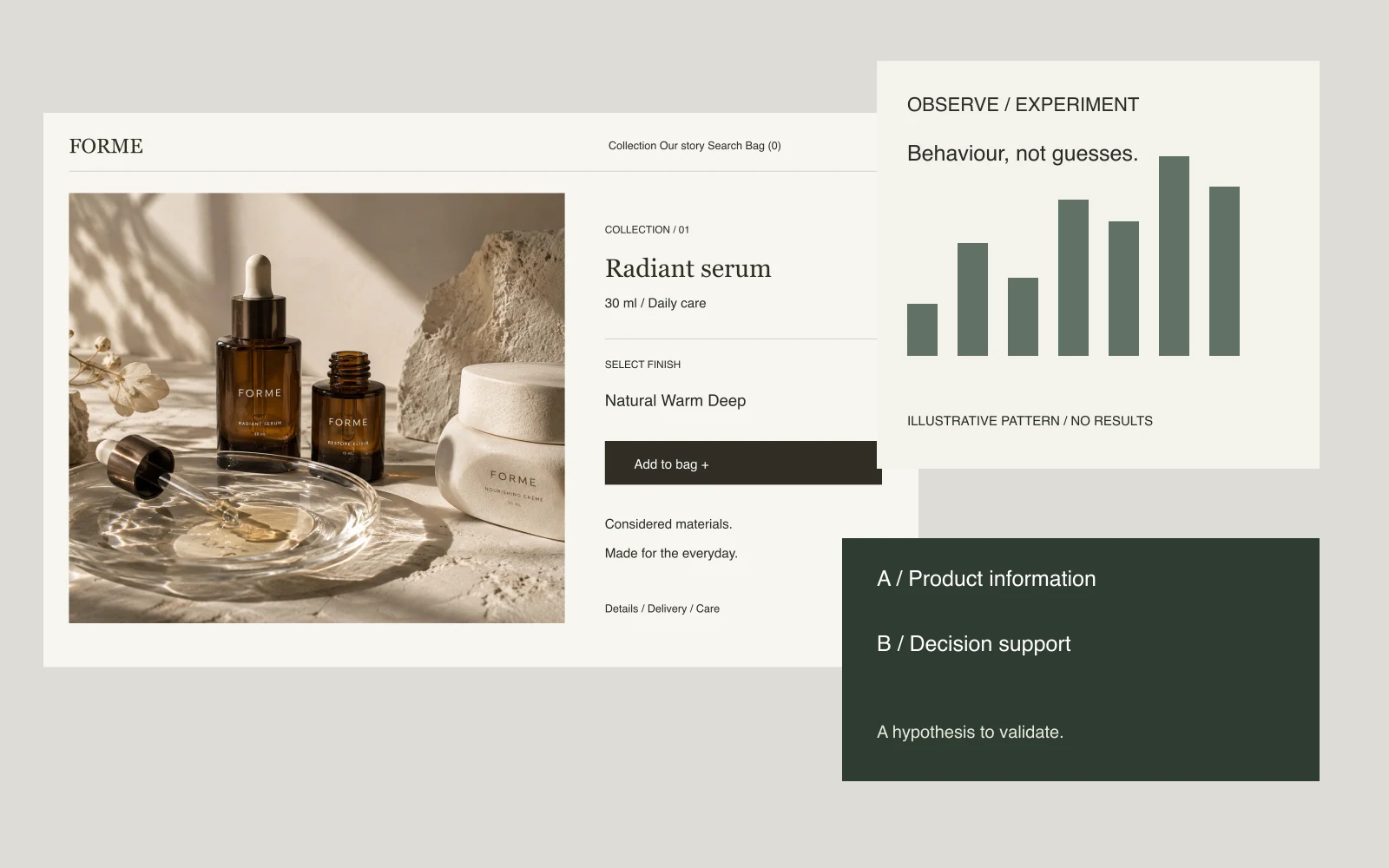
Observe and analyse
Combine analytics, customer feedback and behaviour research. Check measurement quality before interpreting a funnel.
Prioritise
Compare likely impact, evidence, effort and operational dependencies. Keep the commercial question explicit.
Experiment
Define the hypothesis, primary measure and guardrails. Use A/B testing when traffic supports it; use research when it does not.
Implement
Improve PDPs, navigation, search, cart, checkout, landing pages, site speed, merchandising, mobile UX, forms and content hierarchy.
Measure and repeat
Assess the result, record what was learned and update the development roadmap. Include retention, upsell and cross-sell where relevant.
SCOPE / OWNERSHIP / NEXT STEPS
When the funnel shows a problem but not its cause
For trading teams with unanswered questions about discovery, product choice or checkout. Check event accuracy and segment differences before interpreting a headline conversion rate.
Concrete deliverables
A measurement review, prioritised hypothesis backlog, experiment or research plan, implementation scope and a decision record describing results and uncertainty.
Who does what
Your team provides analytics access, trading context and campaign dates. VIA77 defines the method; both teams agree the primary measure and commercial guardrails before a change ships.
Investment, timing and support
Traffic, seasonality, purchase frequency and measurement quality govern timing. Lower-traffic stores may need task research instead of an underpowered A/B test. Ongoing scope follows the evidence.
A useful question: Can you guarantee a conversion uplift?
No. An experiment can be inconclusive or negative. The useful outcome is a defensible decision, including reverting a change when the evidence does not support it.
Compare a rebuild with targeted improvement Define the priorities first
USEFUL QUESTIONS
Before we begin.
How much does a Shopify website cost?
Scope drives the investment: catalogue complexity, UX, integrations, migration and ongoing support all matter. The project form uses indicative investment bands starting at A$15k–A$30k to guide the conversation; these are not fixed quotes.
How long does a project take?
Timing depends on scope, content readiness, system access and decision-making. Discovery establishes the dependencies and an achievable delivery plan before a launch date is committed.
Can VIA77 work with our existing ecommerce team?
Yes. The engagement can complement an internal team, with responsibilities, decision points and handover requirements agreed at the beginning.
What happens after launch?
A launch should include monitoring and a clear owner for operational issues. An ongoing optimisation engagement can then turn customer behaviour and research into a prioritised improvement roadmap.
Find the next growth opportunity.
Start a projectExplore Commerce AssessmentYOUR NEXT CHAPTER
What are you
trying to build?
Tell us where your ecommerce business is now, where you want it to go and what’s getting in the way.
Start a projectMelbourne / Working across Australia