
SOLUTION / Advanced Commerce
When standard ecommerce isn’t enough.
Complex commerce should still feel simple to the customer. VIA77 designs and engineers commerce systems for businesses with advanced operational, customer and technology requirements.
What is advanced commerce?
Advanced commerce connects a storefront to the operational systems and customer requirements that sit beyond a standard online catalogue. It can include ERP and PIM integrations, B2B purchasing, subscriptions, multi-market selling and custom applications. VIA77 starts with the workflow and its constraints, then defines the smallest reliable architecture that supports the business without adding unnecessary complexity.
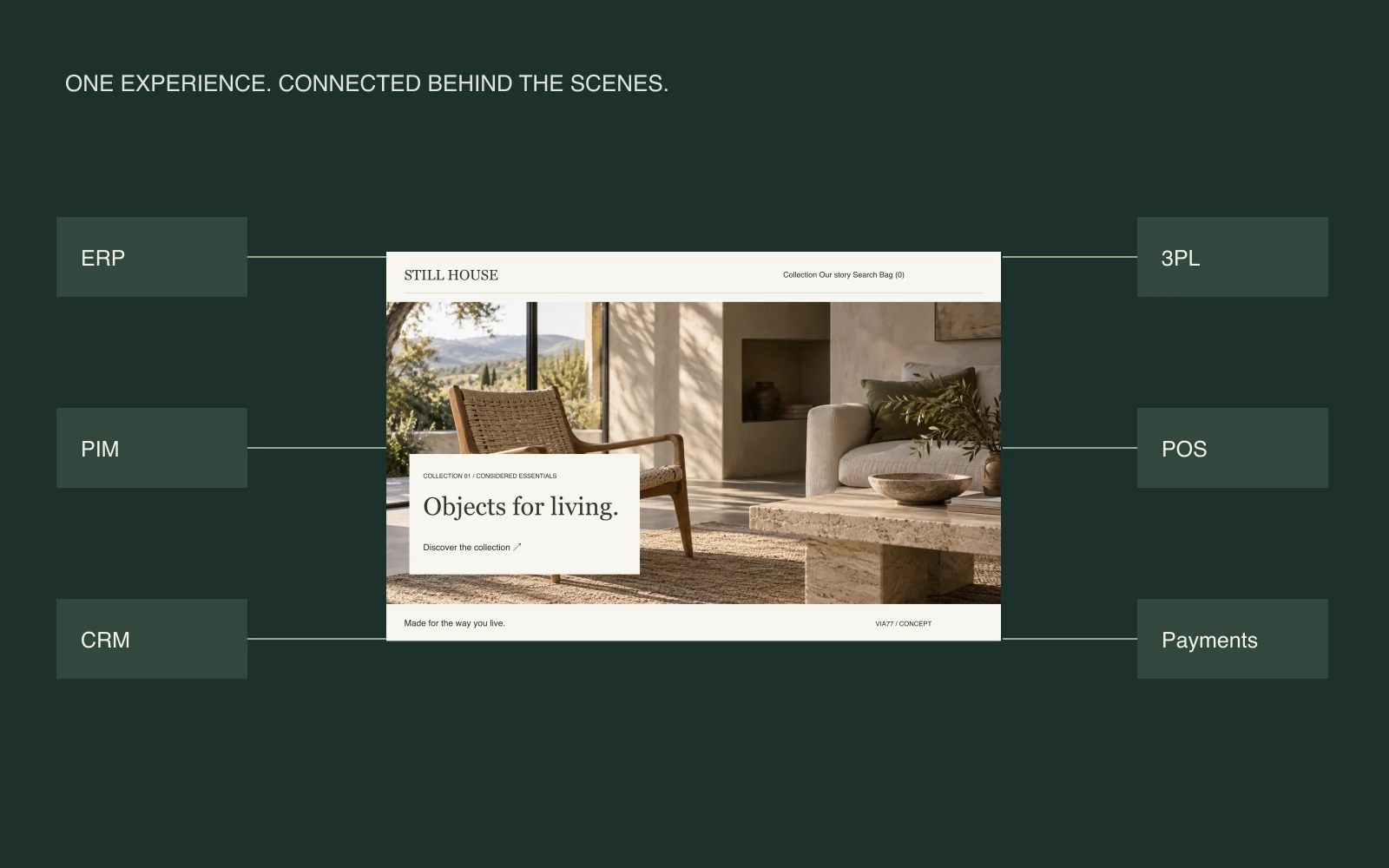
Connected operations
ERP, PIM, CRM, POS, 3PL and API architecture, with ownership, failure handling and reconciliation defined.
Different ways to buy
B2B commerce, wholesale, subscriptions and memberships built around the actual customer relationship.
Across markets
Multi-market and multi-currency experiences that account for catalogue, payment and fulfilment differences.
Purposeful customisation
Advanced search, custom applications, product configurators and checkout extensions where supported by the selected plan and architecture.
Complexity belongs behind the experience.
Customer-facing UX should remain clean even when the systems underneath are sophisticated.
Headless where justified
Evaluate headless architecture against a specific constraint, including ownership, maintenance and total operating cost.
One connected system.
ERP
Synchronise products, inventory, orders, pricing and operational data between ecommerce and your core business systems.
CRM
Connect customer records and consent-aware lifecycle information so service and marketing teams work from a consistent view.
PIM
Keep product attributes, specifications, media and taxonomy consistent across storefronts and channels.
POS
Connect store and online trading workflows, with clear rules for stock, returns and customer identity.
3PL
Pass fulfilment instructions to logistics providers and reconcile shipment status, exceptions and tracking.
Payments
Define payment methods and reconcile successful, pending and failed transactions against order state.
Subscriptions
Coordinate recurring purchase options, customer changes and fulfilment with clear ownership.
Search
Use consistent product attributes and useful filtering to help people find and compare products.
Connect consent, lifecycle events and customer communications to the actual purchase journey.
Customer Service
Give support teams the order and customer context needed to resolve real customer questions.
Analytics
Validate event collection and use reliable customer journey data to guide improvement.
Loyalty
Connect rewards and account behaviour with explicit eligibility and redemption rules.
SCOPE / OWNERSHIP / NEXT STEPS
When systems disagree about an order
For teams reconciling inventory by hand or repeating product and customer updates across systems. Begin with one complete workflow and its exceptions.
Concrete deliverables
A source-of-truth map, API and event specification, field transformations, retry rules, reconciliation checks and a support runbook with named owners.
Who does what
Your ERP, PIM or 3PL owner provides documentation and test access. VIA77 implements the agreed connection; each vendor validates its own system behaviour and limits.
Investment, timing and support
API limits, sandbox availability, event volume and legacy data quality determine timing and investment. Monitoring must distinguish delayed events from failed or duplicated operations.
A useful question: Should every update be real time?
No. Choose event-driven updates or scheduled reconciliation based on stock risk and operational need. Faster synchronisation can add cost and more failure states.
Explore advanced commerce architecture Define the priorities first
USEFUL QUESTIONS
Before we begin.
Can VIA77 integrate our ERP?
Feasibility depends on the ERP, available APIs, data ownership, licensing and the workflows in scope. We assess those constraints before committing to an integration approach.
How long does a project take?
Timing depends on scope, content readiness, system access and decision-making. Discovery establishes the dependencies and an achievable delivery plan before a launch date is committed.
Can VIA77 work with our existing ecommerce team?
Yes. The engagement can complement an internal team, with responsibilities, decision points and handover requirements agreed at the beginning.
What happens after launch?
A launch should include monitoring and a clear owner for operational issues. An ongoing optimisation engagement can then turn customer behaviour and research into a prioritised improvement roadmap.
Discuss your commerce architecture.
Start a projectExplore Commerce AssessmentYOUR NEXT CHAPTER
What are you
trying to build?
Tell us where your ecommerce business is now, where you want it to go and what’s getting in the way.
Start a projectMelbourne / Working across Australia